


The Future of Care: How AI and digital health tools are improving diagnostic accuracy in oncology. May 14, 2026 – Posted in: Oncology
The landscape of cancer care is undergoing a seismic shift. For decades, the “gold standard” of diagnosis relied heavily on the human eye—pathologists peering through microscopes and radiologists scanning grainy films. While their expertise remains irreplaceable, the sheer volume of medical data has outpaced human processing power. Enter the era of augmented oncology: a future where Artificial Intelligence (AI) and digital health tools act as a powerful co-pilot, narrowing the margin for error and catching what was once invisible.
Breaking the Bottleneck of Complexity
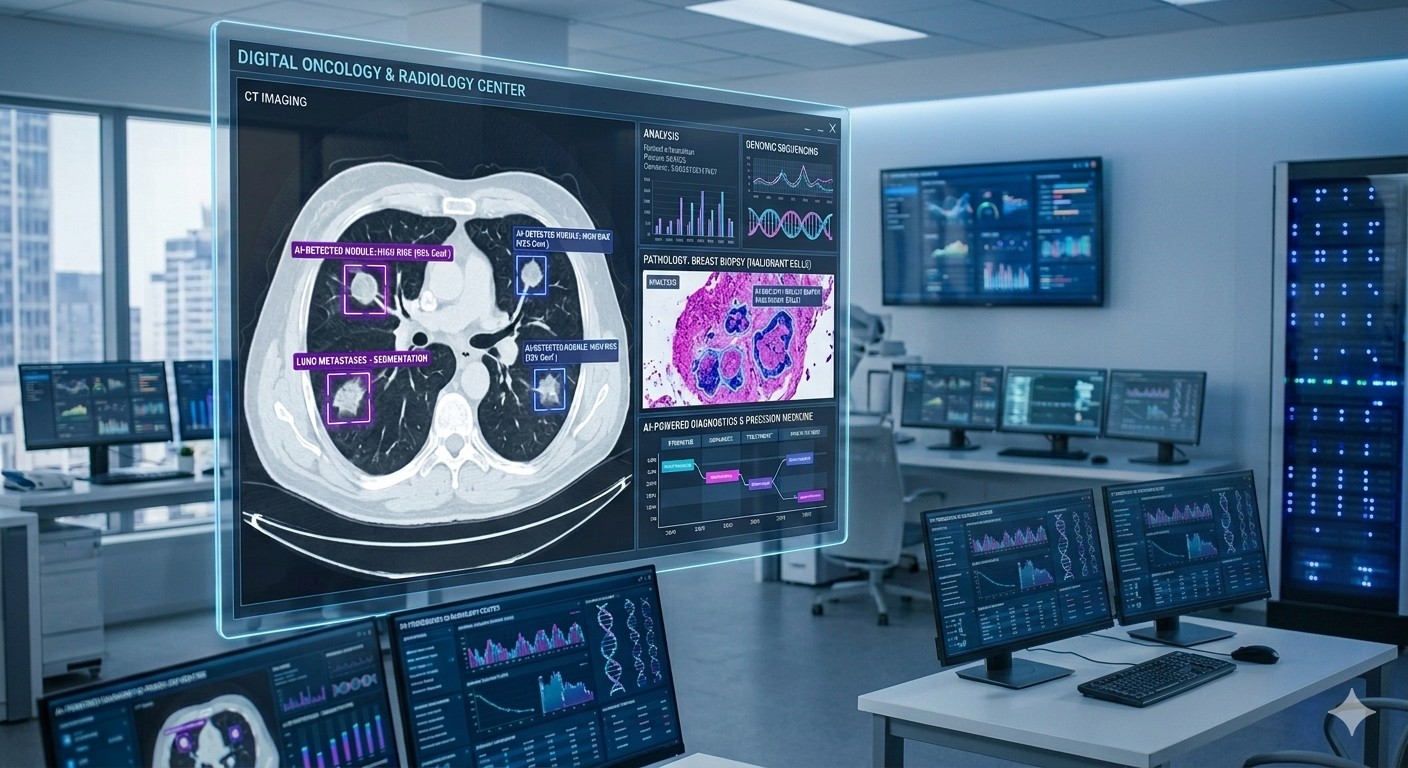
Diagnostic accuracy in oncology is notoriously difficult because cancer is not one disease, but thousands of variations. AI excels at identifying patterns within this complexity. In radiology, deep-learning algorithms are now trained on millions of images to spot malignant nuances in mammograms or lung CT scans that might be missed by a fatigued physician. These tools act as a “second set of eyes,” flagging suspicious areas for immediate review and significantly reducing both false negatives and the anxiety of false positives.
Digital Pathology: From Glass to Gigabits
One of the most transformative leaps is the transition to digital pathology. By converting traditional tissue slides into high-resolution digital files, AI can perform “computational staining” and automated cell counting. Algorithms can analyze the morphology of tumour cells with mathematical precision, grading the aggressiveness of a cancer more consistently than manual observation. This ensures that a patient’s diagnosis is not subject to the subtle variations in interpretation between different doctors, leading to a more standardized and accurate baseline for treatment.
The Power of Multi-Modal Data
The real “magic” of AI in the future of care lies in its ability to synthesize diverse data streams. Digital health tools now allow clinicians to integrate genomic sequencing, electronic health records, and even real-time data from wearable devices.
While a human doctor might struggle to find the link between a specific genetic mutation and a subtle trend in a patient’s blood work, AI can process these “multi-omic” datasets simultaneously. This holistic view enables precision diagnostics, where the goal is not just to identify ” cancer,” but to identify the specific molecular driver of that patient’s unique tumour. Accuracy, in this context, moves from simply naming the disease to predicting exactly how it will respond to specific therapies.
Empowering the Human Element
Critically, the future of AI in oncology is not about replacing doctors; it is about liberating them. By automating the routine, data-heavy aspects of diagnostics, digital tools give oncologists more time to focus on the “care” in healthcare—discussing treatment plans, managing side effects, and providing emotional support.
As we look ahead, the integration of AI will move diagnostics from a reactive “snapshot” to a proactive, continuous monitor. With earlier detection and hyper-accurate staging, the path to a cure becomes clearer, faster, and more personal than ever before. The future of care is not just digital; it is undeniably more precise.